In this short post I want to explore a simple and hopefully intuitive geometric interpretation of a common vector operation; the 3D cross product.
We’ll start by breaking down a somewhat related operation in 2D, sometimes called the perpendicular dot product or just perp dot product. It describes the area 


One way to interpret this is that we are subtracting the area of the rectangle 
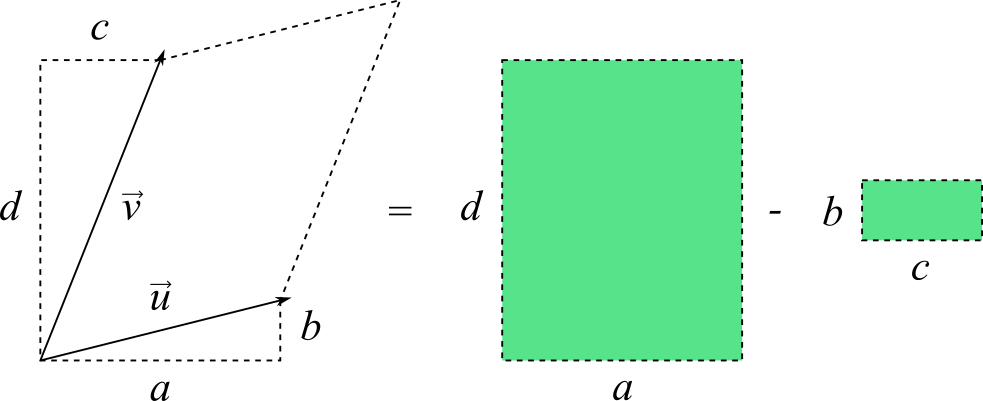
We can put together a simple visual proof by cutting out and rearranging portions of the larger rectangle to show that the smaller rectangle simply cancels out the extra and overlapping areas:
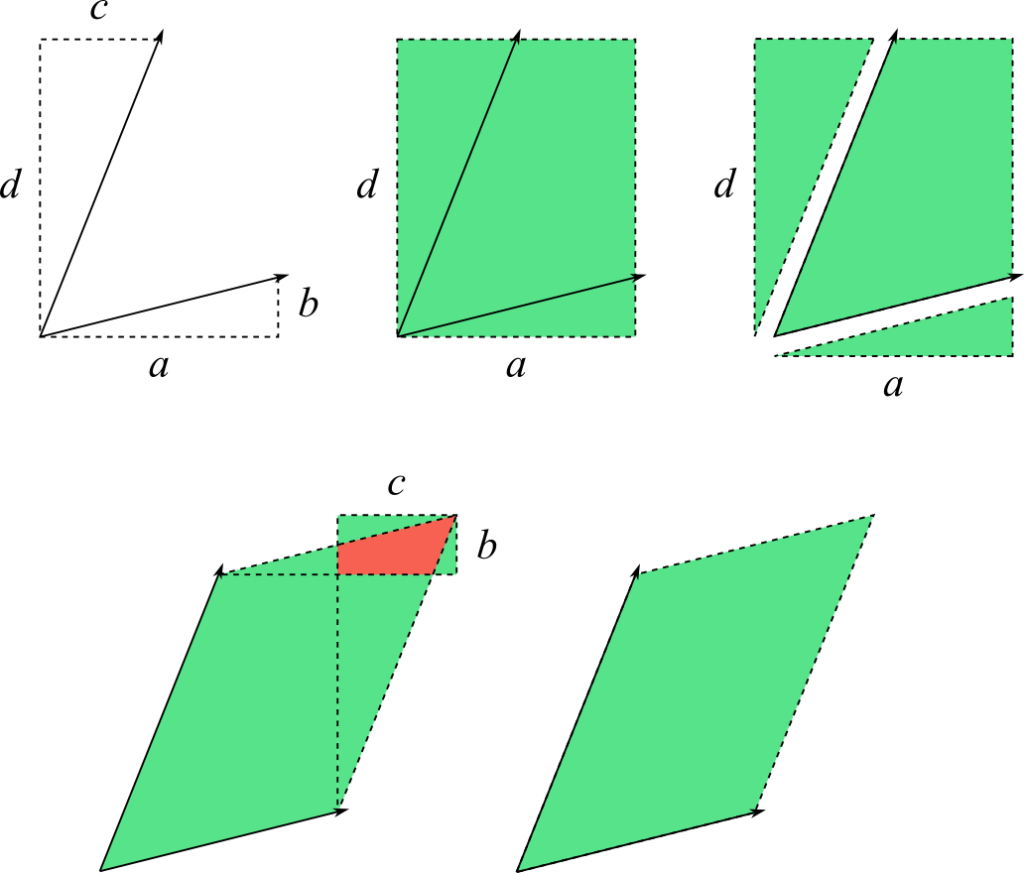 compensates for the extra area introduced by rectangle
  . The area highlighted in red indicates an overlap between the parallelogram and .
Notice that the area of a triangle with two sides given by the vectors 


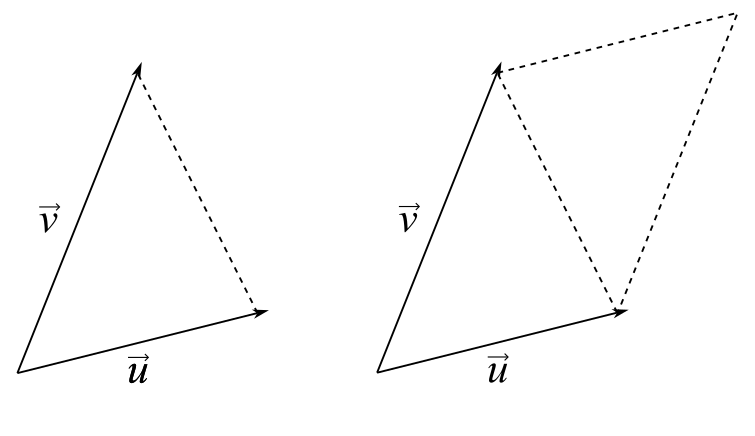 and define a triangle as well as a parallelogram of exactly twice the triangle’s area.
In Three Dimensions
We can take the geometric interpretation of the perp dot product to get a more intuitive understanding of the 3D cross product, albeit with a few more steps. The cross product of two vectors 

Notice that the cross product operation can be interpreted as three separate perp dot products describing the projection of our original parallelogram onto each of the three coordinate planes. For example, the operation 

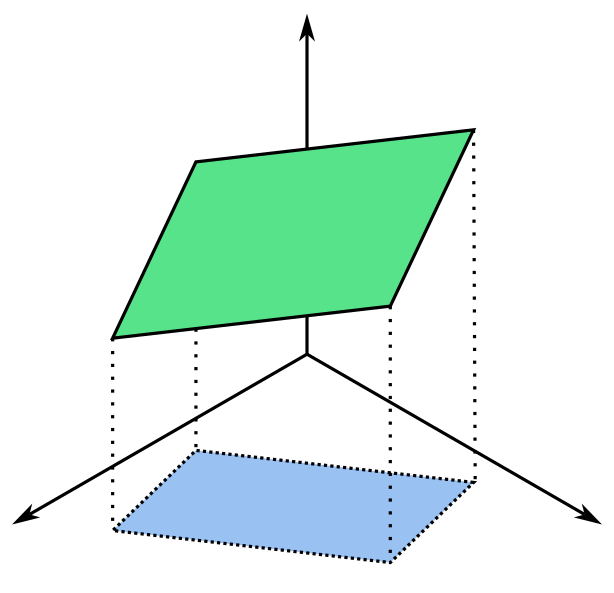
The next step is to intuit what it means to take the magnitude of a vector whose components represent the areas of these projected parallelograms. Recall the formula for taking the magnitude of a 3D vector

This looks like the formula for Euclidean distance, which is derived from the Pythagorean theorem most of us are familiar with. Just to quickly recap, Pythagoras’ theorem states that the squared length of the hypotenuse 


Or, in terms of the length

If we choose to express 
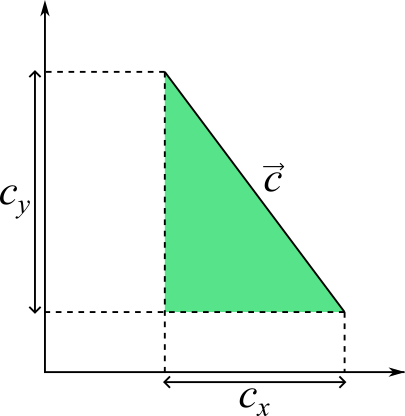
Thus, by the Pythagorean theorem:

It turns out that this actually generalises to higher dimensions. If we take a triangle in 3D, project it onto each of the three coordinate planes and find the area of each projected triangle, the sum of squares of those areas is equal to the squared area of the original triangle!
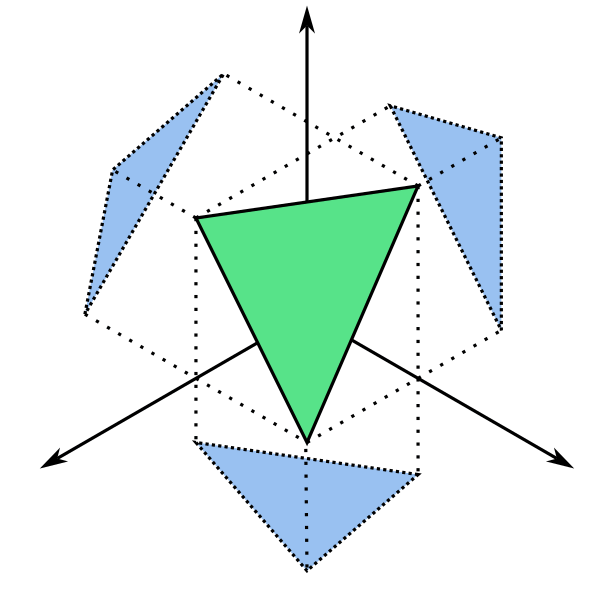
We can show that this is true by taking what we know about the perp dot product and Pythagoras’ theorem to get the area of a parallelogram just as we would by using the cross product. Let 


We can factor and simplify to take the 

Which we find is equivalent to the following according to the definition of the cross product:

Double the result and you have the area of the parallelogram spanned by

 matejlou's blog